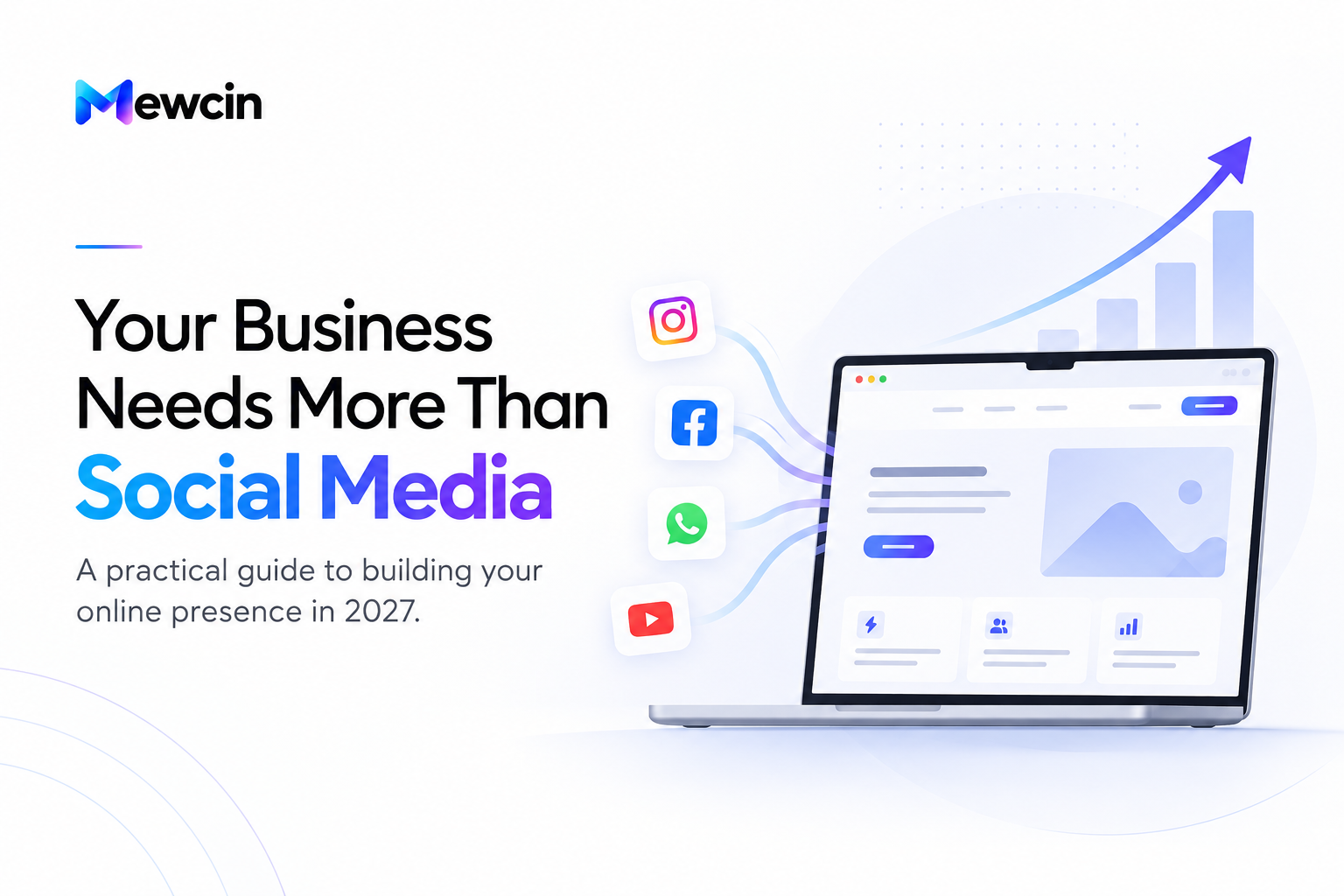
Running a business today means competing for attention online. Whether you own a dental clinic, salon, restaurant, gym, consultancy, or startup, your potential customers are looking for information before deciding whom to trust.
Many businesses depend on Instagram, Facebook, and WhatsApp to connect with customers. These platforms are useful, but they don't give you complete control over your online presence.
A professional website gives your business a dedicated digital home—one where you control the experience, communicate your value, showcase your services, and make it easier for potential customers to take the next step.
So, does your business really need a website in 2027? Let's break it down.
1. Build Credibility and Make a Strong First Impression
Imagine a potential customer hears about your business and searches for it on Google. They find your social media profile, but there's no website explaining your services, pricing, experience, or contact information.
That missing information can create unnecessary uncertainty.
A professional website helps answer the questions customers naturally have before making a decision:
- What does your business offer?
- Why should someone choose you?
- What makes your services different?
- Where are you located, and how can customers contact you?
- Can they see examples of your work or read customer testimonials?
A well-designed website brings these details together in one place. Consistent branding, clear messaging, genuine testimonials, and accessible contact information help establish trust.
Your website cannot replace the quality of your actual service, but it can make your business easier to understand and evaluate.
2. Reach Customers Through Google Search
Social media helps people discover your business while browsing. Search engines help people find businesses when they're actively looking for a particular product or service.
Consider these searches:
- Dentist near me
- Best salon in Kolkata
- Website development company in India
- Personal trainer near me
- Restaurant with online reservations
These searches reveal a specific need. If your business offers the service someone is searching for, appearing in relevant results can introduce you to potential customers.
This is where Search Engine Optimization (SEO) becomes important.
SEO involves improving your website's content, structure, technical performance, and relevance so search engines can better understand your business and potentially show it for relevant searches.
A strong SEO foundation includes:
- Relevant page titles and meta descriptions
- Useful, original content that answers customer questions
- Dedicated pages for important services
- Fast loading speeds and mobile-friendly layouts
- Descriptive URLs and logical website navigation
- Proper indexing and technical SEO
- Relevant internal links between pages
For businesses serving a specific area, local SEO is equally important. Your website can support your Google Business Profile by providing consistent business information and relevant details about your services and location.
One important distinction: having a website does not automatically put you at the top of Google. Rankings depend on numerous factors, including competition, relevance, content quality, and your site's overall performance. SEO is an ongoing process, not an instant result.
3. Your Website Works Beyond Business Hours
Your team might finish work at 8 PM, but potential customers may search for your services at midnight.
A website allows people to explore your business whenever it suits them, without requiring someone from your team to respond immediately.
Depending on how it's built, your website can let visitors:
- Explore your services and pricing
- Browse your portfolio or product catalogue
- Submit an enquiry form
- Request an appointment or consultation
- Find your location and contact information
- Read frequently asked questions
- Make purchases or payments through supported integrations
For example, a dental clinic can use its website to explain treatments, introduce its practitioners, answer common questions, and collect appointment requests.
A gym can display membership options and personal training services. A restaurant can publish its menu and provide reservation or ordering options.
These features reduce friction for potential customers and make the next step clearer.
Your website won't manage every customer interaction automatically, but it can handle much of the initial information-sharing process.
4. You Own More of Your Digital Presence
Building your entire online presence around one social media platform creates dependency.
Algorithms change. Features disappear. Accounts can be compromised or restricted. Organic reach can fluctuate without warning.
You don't control those platforms, and you cannot guarantee that every follower will see your content.
A website gives you substantially more control over your content, branding, navigation, and customer journey. With your own domain and appropriate hosting arrangements, you have a central digital asset that isn't tied to the continued availability of a particular social media account.
This doesn't mean social media is a bad investment. Far from it.
Instagram is excellent for visual discovery. LinkedIn can help with professional networking. WhatsApp is convenient for direct communication. Google Business Profile helps local customers discover businesses.
The stronger strategy is to use these channels together.
Use social media to attract attention, search engines to improve discoverability, and your website to provide information and convert interest into enquiries.
5. Turn Website Visitors Into Potential Customers
Getting visitors to your website is only part of the job. You also need to make it easy for them to act.
This is where conversion-focused design matters.
A website should guide visitors toward a clear next step instead of leaving them wondering what to do.
Depending on your business, that action might be:
- Request a quote
- Book a consultation
- Schedule an appointment
- Call your business
- Send an enquiry through WhatsApp
- Purchase a product
- Sign up for a service
Effective conversion design combines clear messaging, intuitive navigation, visible calls to action, fast performance, and forms that ask only for necessary information.
For example, a web development agency should clearly explain its services, show relevant projects, describe its process, and provide a straightforward way to start a project.
A local clinic may prioritise appointment requests and contact information instead.
The objective isn't to add as many buttons as possible. It's to help the right visitor take the right action with minimal confusion.
You can also use analytics and conversion tracking, with appropriate privacy practices, to understand how visitors interact with your site and identify areas for improvement.
6. Create a Stronger Brand Identity
Your social media profile is restricted by the platform's layout and features. A website offers far more freedom to express your brand.
You can control the visual hierarchy, typography, colours, imagery, messaging, page structure, and interactions that shape the customer experience.
A thoughtfully designed website can communicate whether your business is professional, approachable, innovative, premium, or focused on a particular industry.
It can also bring your brand's different elements together in a consistent experience.
This is particularly useful for startups and growing businesses that want to differentiate themselves in competitive markets.
However, impressive visuals alone aren't enough. A visually attractive website with confusing navigation, slow performance, or unclear messaging will still frustrate visitors.
Good web design balances aesthetics with usability, accessibility, and business objectives.
7. Build a Digital Asset That Can Grow With Your Business
Your website should reflect where your business is today while leaving room for where it wants to go.
You might begin with a simple website containing your homepage, services, about page, and contact details. As your business grows, you can add functionality based on actual needs.
That could include:
- A blog or resource centre
- Additional service and location pages
- Online bookings and appointment management
- E-commerce and payment integrations
- Customer relationship management (CRM) systems
- Content management systems (CMS)
- Customer portals and web applications
- Marketing automation and analytics integrations
You don't need every feature on day one.
A small business that needs a simple online presence shouldn't spend money on complex software it won't use. Equally, a business with specialised workflows may eventually outgrow a basic template website.
The right solution depends on your business model, budget, customers, and operational requirements.
Planning for scalability means choosing an appropriate foundation—not building unnecessary complexity in advance.
8. What Should a Professional Business Website Include?
Before investing in a website, make sure it covers the fundamentals.
Essential website checklist
Clear messaging: Visitors should quickly understand what you do, whom you serve, and what makes your business relevant to them.
Responsive design: Your website should work properly on mobile phones, tablets, and desktop computers.
Fast performance: Optimised images, efficient code, and appropriate hosting help reduce loading delays.
Useful service pages: Explain your offerings, benefits, process, and relevant details instead of relying on vague descriptions.
Visible contact options: Include appropriate contact details, enquiry forms, and booking links.
Trust signals: Use genuine testimonials, authentic project examples, professional credentials, and accurate business information where relevant.
SEO fundamentals: Make pages crawlable, use descriptive titles and headings, and provide useful content for your target audience.
Security and accessibility: Use HTTPS, keep relevant software updated, protect forms, and make the site usable by people with different abilities.
Analytics: Measure meaningful actions, such as qualified enquiries or appointment requests, rather than focusing exclusively on visitor counts.
A website doesn't have to be enormous to be effective. It needs to serve its audience well and support a clearly defined business objective.
9. How Much Does a Business Website Cost in India?
There is no single price for a professional website. The cost depends on its scope, design requirements, functionality, integrations, content, and ongoing maintenance needs.
A simple business website has very different requirements from a custom web application or e-commerce platform.
When comparing proposals, consider more than the initial development fee:
- Domain registration and renewal
- Hosting and infrastructure
- Design and development
- Copywriting and content preparation
- SEO setup
- Third-party tools and integrations
- Maintenance, security, and future updates
Ask what is included, who owns the domain and website assets, what ongoing costs apply, and whether future changes are covered.
The cheapest option isn't automatically the worst, and the most expensive option isn't automatically the best. Choose a solution that meets your actual requirements and offers a clear path for future improvements.
A website should be treated as a business investment with measurable objectives, not as a guarantee of revenue.
10. Website vs Social Media: Do You Need to Choose?
No. For most established small businesses, these channels serve different purposes and work best when used together.
| Website | Social media |
|---|---|
| Gives you greater control over your online presence | Helps you reach and engage audiences on third-party platforms |
| Supports long-term content and SEO efforts | Supports ongoing conversations and content distribution |
| Allows customised user journeys and functionality | Provides platform-defined features and formats |
| Can collect enquiries, bookings, or purchases | Can direct interested people toward your website or contact channels |
| Requires investment in setup and maintenance | Requires consistent content and audience engagement |
Neither channel guarantees customers on its own.
A website with poor content and no traffic strategy may generate few enquiries. A social media account with an engaged, relevant audience can generate meaningful business.
The goal is to build a connected digital presence in which each channel has a clear purpose.
11. Common Website Mistakes Small Businesses Should Avoid
Simply having a website isn't enough. Avoid these common mistakes:
Designing only for appearance. Attractive visuals should support clear navigation, readable content, and useful actions.
Ignoring mobile users. A layout that works on a laptop but breaks on a phone creates unnecessary friction.
Treating SEO as a one-time task. Technical setup matters, but useful content, competition, and ongoing improvements also influence performance.
Using generic content. Explain what your business actually does, who it serves, and what customers can expect.
Hiding contact information. Visitors shouldn't have to search through multiple pages to find a phone number or enquiry form.
Neglecting maintenance. Outdated information, broken links, expired integrations, and security issues can undermine an otherwise good website.
Expecting instant results. A website is infrastructure. Generating meaningful traffic and enquiries requires a combination of quality, visibility, relevance, and ongoing work.
Avoiding these mistakes helps you get more value from your investment.
Frequently Asked Questions
Is a website necessary if my business already has an Instagram page?
Not necessarily for every business at every stage, but a website offers greater control over your brand, content, customer journey, and functionality. Social media and a website can complement each other rather than compete.
Can a website help my business rank on Google?
Yes. A well-structured website with relevant content and sound technical SEO can become eligible to appear for relevant searches. However, rankings and traffic are not guaranteed and can take time to develop.
How long does it take to build a business website?
It depends on the scope. A straightforward website may take days or a few weeks, while complex websites and applications can take considerably longer. Content readiness, feedback, integrations, and revisions all affect delivery time.
Do small businesses need custom websites?
Not always. A website builder or established CMS may be sufficient for a business with straightforward requirements. Custom development becomes more useful when you need specialised functionality, integrations, or a user experience that standard solutions cannot deliver effectively.
Should I invest in SEO when launching my website?
Yes, at least in the fundamentals. Make sure your pages are accessible to search engines, your content answers relevant questions, your site performs well, and your business information is accurate. More extensive SEO work can be prioritised according to your market and growth objectives.
Will a website automatically generate leads?
No. A website creates opportunities to attract and convert visitors, but results depend on factors such as traffic quality, search visibility, offer quality, user experience, competition, and follow-up processes.
Final Thoughts: Build a Digital Presence That Works for Your Business
Your business doesn't need a website simply because every other business has one. It needs a website when having a dedicated, well-designed digital presence can help customers understand your offerings, find relevant information, and take meaningful action.
Social media can help people discover you. Search engines can connect you with people looking for your services. A well-built website brings your brand, information, and customer journey together.
The key is to build with purpose: understand your audience, choose the right functionality, prioritise performance and usability, and improve the experience as your business evolves.
At Mewcin, we help businesses turn ideas into modern digital experiences through thoughtful web design, custom development, SEO, and ongoing support. Whether you need a landing page, a business website, or a more tailored digital solution, we focus on building around your goals.
Ready to build a stronger online presence?
Let's discuss what your business needs and find the right solution.